
Window Tinting in San Leandro, CA helps vehicle owners reduce cabin heat, control harsh sunlight, and make everyday commuting more comfortable. Whether you spend time on I-880, travel along I-580, or sit in traffic near Davis Street and Marina Boulevard, sunlight entering your vehicle can warm the seats, dashboard, and steering wheel. The right window tint can reduce solar energy entering through the glass without making every window extremely dark.
But here’s the catch: not all window tint rejects heat equally.
A dark window film may reduce glare and provide privacy, yet offer less heat rejection than a lighter ceramic film. That’s why choosing window tint based only on appearance can leave you disappointed, especially when your main goal is a cooler cabin.
At XCare Auto Films, we install XPEL automotive window tint for customers from San Leandro, CA, San Lorenzo, CA, Hayward, CA, and nearby East Bay communities. Our XPEL-certified team specializes in XPEL PRIME XR PLUS, a multi-layer nano-ceramic window film designed to reject infrared heat, block UV rays, and reduce glare.
We install these films at our Fremont, CA shop and help vehicle owners compare film performance, shade choices, and suitable window coverage.
In this guide, we’ll explain how automotive window tint controls heat, compare common film types, break down XPEL’s performance ratings, review California tint laws, and help you choose a window film for your East Bay commute.
Table of Contents
- Why San Leandro Drivers Choose Window Tint
- How Window Tint Reduces Cabin Heat
- Understanding Heat Rejection Ratings
- Window Tint Film Types Compared
- XPEL PRIME Window Tint Comparison
- XPEL PRIME XR PLUS Ceramic Window Tint
- Does Darker Tint Reject More Heat?
- Window Tint Percentages Explained
- California Window Tint Laws
- Window Tint for East Bay Commuting
- Which Windows Should You Tint?
- Window Tint for Tesla and Electric Vehicles
- What Happens During Installation?
- What Affects Window Tint Cost?
- How to Care for New Window Tint
- Window Tint Warranty Information
- Why Choose XCare Auto Films?
- Schedule Window Tinting Near San Leandro
- Frequently Asked Questions
- Sources
Why Window Tinting in San Leandro, CA Makes Sense for East Bay Drivers
San Leandro, CA sits along two major East Bay transportation routes, I-880 and I-580.
Many local vehicle owners also use Davis Street, Marina Boulevard, Washington Avenue, and East 14th Street during their regular trips.
The City of San Leandro’s transportation information identifies several of these roads as important routes for local and commercial traffic.
For commuters, that can mean spending time in slow-moving traffic with sunlight entering through the same side of the vehicle.
Even when the weather outside feels mild, direct sunlight can make the cabin uncomfortable.
Afternoon Sun Can Warm the Cabin Quickly
Think about a car parked outside during the afternoon.
Sunlight passes through the glass and reaches the dashboard, seats, and other interior surfaces.
Those materials absorb energy and become warmer.
When you return to the vehicle, the cabin may feel much hotter than the outdoor air.
Automotive window tint helps reduce the solar energy entering through treated glass.
It won’t eliminate heat buildup, but it can reduce the amount of incoming energy that contributes to the problem.
Glare Can Make Commuting Uncomfortable
Glare is another common complaint.
During morning and afternoon trips, bright sunlight can enter through the side windows.
Window tint reduces incoming visible light, making certain daytime conditions more comfortable.
The goal is to reduce glare without choosing a shade that makes it difficult to see at night.
UV Exposure Matters Too
Automotive window tint can also reduce ultraviolet radiation passing through treated glass.
UV exposure contributes to interior fading and can affect exposed skin.
According to XPEL’s PRIME window tint information, its PRIME CS, PRIME XR, and PRIME XR PLUS film lines provide 99% UV rejection.
That makes UV protection a benefit across several film categories, not only the darkest ceramic products.
Heat rejection, though, is a separate measurement.
How Window Tinting in San Leandro, CA Reduces Heat
To understand Window Tinting in San Leandro, CA, it helps to know what happens when sunlight reaches your car.
Sunlight contains different forms of radiation, including visible light, ultraviolet radiation, and infrared radiation.
These components interact with automotive glass and interior surfaces in different ways.
Window films use dyes, metal-based layers, ceramic particles, or combinations of materials to reduce the amount of solar energy entering the cabin.
Visible Light
Visible light is the part of sunlight that allows you to see.
Darker tint reduces the amount of visible light passing through the glass.
This can help cut glare and increase privacy through suitable windows.
But visible light transmission does not tell the whole story about heat rejection.
Infrared Radiation
Infrared radiation makes up a portion of the solar energy reaching a vehicle.
Premium ceramic films are designed to reject a high percentage of specified infrared wavelengths.
XPEL PRIME XR PLUS is one of the films designed for this purpose.
Ultraviolet Radiation
Ultraviolet radiation can contribute to interior material deterioration.
XPEL’s PRIME automotive films are designed to block a high percentage of UV rays.
A film that rejects UV well does not automatically reject the most solar heat.
Why the Difference Matters
A window film can look dark because it reduces visible light.
That doesn’t necessarily mean it rejects more total solar energy than a lighter ceramic film.
If your biggest concern is the temperature inside your vehicle, pay attention to the film’s heat-rejection measurements rather than shade alone.
Understanding Window Tint Heat Rejection Ratings
When comparing Window Tinting in San Leandro, CA, you’ll see several percentages listed on product pages.
The numbers can be confusing because they measure different properties.
Here are the measurements worth knowing.
Total Solar Energy Rejection (TSER)
TSER measures the percentage of total solar energy rejected by a tested film-and-glass system.
This includes more than just the infrared portion of sunlight.
TSER is one of the most useful measurements when comparing window films for overall heat control.
A higher TSER generally indicates stronger total solar energy rejection under comparable testing conditions.
Infrared Rejection (IR)
Infrared rejection measures how much infrared radiation a film rejects under specific testing conditions.
Manufacturers may measure performance at a particular wavelength.
XPEL publishes an infrared rejection figure of up to 96% for PRIME XR PLUS.
That figure should not be interpreted as blocking 96% of all solar heat.
Infrared Energy Rejection (IRER)
IRER is a broader infrared energy measurement.
XPEL reports up to 70% infrared energy rejection for PRIME XR PLUS on its PRIME comparison page.
This number is different from the manufacturer’s 96% infrared rejection figure.
The two percentages use different measurement approaches.
Visible Light Transmission (VLT)
VLT describes the amount of visible light passing through the film.
A film labeled 35% VLT is darker than one labeled 70% VLT.
VLT helps you compare appearance and visibility, but it is not the same as heat rejection.
UV Rejection
UV rejection measures the amount of ultraviolet radiation blocked by the film under stated testing conditions.
XPEL PRIME films list 99% UV rejection.
For vehicle owners concerned about interior fading and UV exposure, this is worth checking.
Which Measurement Should You Focus On?
If cabin heat is the main concern, review TSER and infrared performance together.
If glare and privacy are also important, compare VLT.
No single percentage describes every part of a window film’s performance.
Window Tint Film Types: Dyed, Carbon, and Ceramic
Window Tinting in San Leandro, CA is available through several film technologies.
Each type has different construction methods and performance characteristics.
Let’s compare three common categories.
Dyed Window Tint
Dyed window tint uses coloring within the film to reduce incoming visible light.
It is often chosen for appearance, privacy, and glare control.
XPEL’s PRIME CS film is a color-stable dyed product.
According to XPEL, PRIME CS provides:
- Up to 35% infrared rejection
- Up to 32% infrared energy rejection
- 99% UV rejection
- Several available shades
- A limited lifetime manufacturer warranty
The manufacturer’s figures vary with the film and testing conditions.
When Does Dyed Tint Make Sense?
Dyed tint may appeal to someone whose main concerns are rear-window privacy and daytime glare.
It provides UV protection and changes the appearance of the glass.
If reducing solar heat is your biggest goal, compare its performance against ceramic film before deciding.
Carbon Window Tint
Carbon window tint uses carbon-based materials as part of its film construction.
It is often selected for its dark appearance and color stability.
Some products also provide solar heat control.
But carbon film performance varies by manufacturer and product.
The word “carbon” alone does not tell you how much total solar energy a film rejects.
When considering carbon window tint, ask for the actual TSER, infrared, UV, and VLT specifications.
XCare Auto Films discusses carbon window film on its window tint service page, while its published ceramic packages feature PRIME XR PLUS.
Ask about current carbon film availability if you’re interested in that type.
Ceramic Window Tint
Ceramic window tint uses ceramic-based particles to reject solar energy.
Premium nano-ceramic film can provide stronger infrared heat rejection than conventional dyed film.
One major benefit is the ability to reject heat without depending entirely on dark glass.
That makes ceramic tint worth considering if you prefer a lighter appearance.
Why Choose Ceramic Tint?
Ceramic window film may appeal to owners who want:
- Stronger heat rejection
- High UV protection
- Reduced daytime glare
- Good outward visibility with suitable lighter shades
- Non-metallic construction
- Several available appearance options
The exact performance still depends on the product and shade.
For customers interested in heat control, our featured product is XPEL PRIME XR PLUS ceramic window tint.
XPEL PRIME Window Tint Comparison: CS vs XR vs XR PLUS
XPEL’s PRIME lineup gives East Bay vehicle owners several different film technologies to compare.
The three products below are part of XPEL’s wider lineup.
XCare Auto Films’ published ceramic packages specifically feature PRIME XR PLUS. Other XPEL products shown here are included for comparison, not as a promise that every film is currently stocked.
| Feature | PRIME CS | PRIME XR | PRIME XR PLUS |
|---|---|---|---|
| Film construction | Color-stable dyed | Nano-ceramic | Multi-layer nano-ceramic |
| Infrared rejection | Up to 35% | Up to 85% | Up to 96% |
| Infrared energy rejection | Up to 32% | Up to 64% | Up to 70% |
| UV rejection | 99% | 99% | 99% |
| Available shades | Multiple | Multiple | Multiple |
| Manufacturer warranty | Limited lifetime | Limited lifetime | Limited lifetime |
| Main appeal | Appearance and glare control | Ceramic heat control | Higher published infrared rejection |
Source: XPEL PRIME Window Tint Comparison
These are maximum manufacturer-published figures under specified test conditions.
The maximum heat-rejection figures and maximum glare-reduction figures do not necessarily apply to the same shade.
What Does This Comparison Tell You?
PRIME CS and PRIME XR PLUS both provide substantial UV protection.
The larger difference is infrared heat rejection.
For someone spending time in East Bay traffic or parking outdoors, that difference may be more noticeable than a small change in tint darkness.
Why Compare the Same Measurement?
Some window tint advertisements focus on infrared rejection at one wavelength.
Others emphasize total solar energy rejection.
Those percentages are not interchangeable.
Try to compare TSER with TSER, or infrared results measured in the same way.
This gives you a better picture of the film’s heat-control performance.
XPEL PRIME XR PLUS Ceramic Window Tint in San Leandro, CA
For Window Tinting in San Leandro, CA, XCare Auto Films features XPEL PRIME XR PLUS.
This film uses multi-layer nano-ceramic technology designed for strong heat rejection and a clear appearance.
Our published ceramic window tint packages list the following performance figures.
| Performance Measurement | XPEL PRIME XR PLUS |
|---|---|
| Infrared rejection | Up to 96% |
| Infrared energy rejection | Up to 70% |
| Total solar energy rejection | Up to 71% |
| UV rejection | 99% |
| Film technology | Multi-layer nano-ceramic |
| Warranty | Limited lifetime |
The percentages are maximum values and vary according to the film shade and testing method.
How Does PRIME XR PLUS Help With Cabin Heat?
PRIME XR PLUS reduces the amount of solar energy entering through treated windows.
This can help limit heat buildup while you’re traveling.
The effect depends on sunlight intensity, the amount of treated glass, the vehicle’s interior, and the selected film.
A vehicle parked in direct sunlight will still become warm over time.
Ceramic tint reduces the incoming solar load. It does not turn a parked vehicle into a climate-controlled space.
Does PRIME XR PLUS Affect Phone or GPS Signals?
XPEL states that its PRIME XR PLUS film does not cause cellular or GPS signal interference.
Its non-metallic ceramic construction is a useful feature for owners of modern connected vehicles.
What About Nighttime Visibility?
The film’s construction does not remove the visibility trade-off associated with dark shades.
A very dark film still allows less visible light through.
For people who travel at night, choosing a suitable legal shade matters just as much as selecting a heat-rejecting product.
Does Darker Window Tint Reject More Heat?
This is one of the most common misconceptions about automotive window tint.
Darker film reduces more visible light, but that does not automatically mean it rejects more total solar heat.
A premium ceramic film can outperform a darker conventional film in solar heat rejection testing.
A Practical Comparison
Imagine comparing two films.
The first is a dark conventional dyed tint.
The second is a lighter ceramic tint.
From outside the vehicle, the dyed film may look much darker.
Yet the lighter ceramic product may reject more infrared energy.
That’s why appearance alone isn’t a reliable way to judge heat performance.
Can a Nearly Clear Film Still Reduce Heat?
Yes, depending on the product.
Some ceramic films provide meaningful solar heat rejection even at higher visible light transmission levels.
But there is another issue to consider.
A film that looks almost clear is not automatically legal for every window in California.
The front side windows and windshield have separate restrictions.
Window Tint Percentages Explained for San Leandro, CA Drivers
Window tint percentages describe visible light transmission.
You may hear people ask for 5%, 20%, 35%, 50%, or 70% tint.
Here’s what those numbers mean.
| Nominal VLT | General Appearance | Visibility Consideration |
|---|---|---|
| 70% | Very light | Allows substantial visible light through |
| 50% | Light | Mild darkening |
| 35% | Moderate | Noticeably darker |
| 20% | Dark | Can reduce outward visibility at night |
| 5% | Very dark | Strongly limits visibility through the glass |
These are appearance descriptions, not recommendations for California front windows.
Is 20% Tint Darker Than 35%?
Yes.
A 20% VLT film transmits less visible light than a 35% film.
That generally makes it look darker.
Does a 35% Film Reject 35% of Heat?
No.
The 35% number describes visible light transmission.
You need the film’s separate solar energy measurements to understand its heat performance.
Does the Factory Glass Affect the Result?
Yes.
Vehicle glass already has its own light-transmission characteristics.
Adding film changes the completed window’s visible light transmission.
A film’s advertised VLT and the final glass-and-film measurement are not necessarily identical.
This distinction is especially important on California front side windows.
California Window Tint Laws for San Leandro, CA
Before scheduling Window Tinting in San Leandro, CA, you should understand California’s rules for automotive window film.
The state treats front side windows, rear windows, and windshields differently.
The governing law is California Vehicle Code Section 26708.
The law includes narrow exceptions for certain materials.
Front Driver and Passenger Windows
California generally restricts aftermarket tint on the front side windows.
Under Section 26708(d), a clear, colorless, transparent UV-protective film may be permitted only when several requirements are met.
These include:
- At least 88% visible light transmission through the film material itself
- At least 70% visible light transmission through the completed glass-and-film assembly
- Compliance with the applicable federal glazing requirements
- Material manufactured for improved UVA protection
- Required certification identifying the installer and manufacturer
- Removal or replacement if the material becomes damaged in a way that obstructs vision
This means a film advertised as 70% VLT does not automatically qualify for the front side windows.
The film material and completed window must satisfy separate requirements.
Rear Side Windows
California generally permits darker film on the side windows behind the front seats, subject to applicable restrictions.
Owners may consider privacy and glare reduction while keeping safe outward visibility in mind.
Rear Windshield
Rear-window tint is generally permitted when the vehicle meets the required outside mirror conditions.
The vehicle must have suitable exterior rearview mirrors on both sides.
Front Windshield
California permits certain material along the uppermost windshield area when the conditions in the law are satisfied.
Separate narrow exceptions address qualifying clear UV-protective materials for certain medical needs.
A nearly clear ceramic film is not automatically permitted across the entire windshield.
XCare Auto Films advertises windshield tinting services, but any proposed application must meet California law.
Why Tint Availability Does Not Mean Legal Approval
Manufacturers sell films in several shades.
A shop may advertise products ranging from very dark to nearly clear.
That does not mean every shade can legally be installed on every window.
Before choosing a shade, ask which applications are permitted on your vehicle.
You can read the California Highway Patrol’s window tint guidance and the California Vehicle Code for more information.
Window Tinting in San Leandro, CA for East Bay Commuting
Different commuting patterns create different needs.
Your choice of window tint should account for where you travel, when you’re on the road, and how long your vehicle sits outside.
I-880 Commuters
I-880 connects San Leandro, CA with Oakland, CA, Hayward, CA, and other East Bay communities.
Long periods of traffic can leave sunlight entering through one side of the vehicle.
If you frequently encounter this situation, consider the film’s total solar energy rejection rather than choosing shade based only on appearance.
A ceramic film can reduce some of the solar load reaching your passengers and interior surfaces.
I-580 Commuters
I-580 connects parts of the East Bay with communities farther inland.
Some motorists spend long periods exposed to direct sunlight while traveling or sitting in congestion.
Window tint can help reduce heat entering through eligible treated glass.
For commuters who also travel after dark, choosing a shade with suitable visibility is worth discussing.
Local Trips Around Davis Street
Davis Street is an important San Leandro, CA roadway connecting local traffic with the I-880 area.
If much of your travel involves shorter trips and outdoor parking, cabin heat buildup while parked may be one of your biggest concerns.
Ceramic window film can help reduce incoming solar energy, but it cannot prevent a closed vehicle from becoming hot.
Family Vehicles Traveling Around San Lorenzo, CA
If you frequently carry rear passengers, the rear side windows may be worth reviewing.
Ceramic tint can reduce sunlight entering through the treated glass.
A suitable rear shade may also provide privacy.
Remember that darker film reduces visibility in low-light conditions.
Commuting Between San Leandro and Hayward
For motorists traveling between San Leandro, CA and Hayward, CA, heat rejection may matter more than achieving a very dark appearance.
Ask about the balance between film performance, visibility, and legal coverage.
The right product should match the way you actually use your vehicle.
Which Windows Should You Tint for Better Heat Rejection?
Window Tinting in San Leandro, CA can involve different groups of glass depending on your vehicle and the legal applications available.
XCare Auto Films advertises ceramic tint packages for side and rear glass, along with separate glass-area options.
Rear Side Windows
Rear side windows are often considered by owners who want heat reduction for passengers.
They can also provide additional privacy with suitable film shades.
Rear Windshield
The rear glass can be a large source of sunlight entering the cabin.
Ceramic tint on a suitable rear window can reduce solar energy entering from behind.
If the vehicle has a rear defroster, ask about the installation process and how the film will be handled around the heating lines.
Front Side Windows
California’s front side window rules are much stricter.
The available compliant material must meet the applicable conditions, including the required light-transmission and certification standards.
Do not assume the standard PRIME XR PLUS shade range is permitted on California front windows.
Sunroof and Panoramic Roof
Many modern vehicles have large sunroofs or glass roof panels.
These surfaces can allow sunlight into the cabin.
XCare Auto Films lists ceramic sunroof tinting among its services.
Before applying film, the glass type, vehicle manufacturer instructions, and film compatibility should be reviewed.
Some glass roofs already have factory solar treatments.
Windshield
The windshield is one of the largest glass areas on many vehicles.
It is also subject to strict legal and visibility requirements.
Any windshield tint application should be evaluated against the specific California exceptions before installation.
If your main concern is heat entering through the windshield, ask about lawful options rather than assuming a transparent-looking film is automatically permitted.
Ceramic Window Tint for Tesla and Electric Vehicles in San Leandro, CA
Tesla and other electric vehicle owners frequently ask about ceramic window tint because many models have large glass areas.
Tesla Model 3 and Model Y vehicles, for instance, have expansive windows and glass roof designs.
These surfaces can contribute to sunlight entering the passenger cabin.
Why Ceramic Tint Appeals to EV Owners
XPEL PRIME XR PLUS provides heat-rejection and UV-protection properties through its nano-ceramic construction.
Owners can compare film options without assuming the darkest available tint is necessary.
The final choice should account for the glass, visibility, and California law.
Can Window Tint Help Reduce Air Conditioning Demand?
Reducing the amount of solar heat entering a vehicle can reduce some of the cooling load under certain conditions.
But any change in energy consumption depends on the vehicle, outside conditions, cabin settings, and use.
Do not expect a guaranteed range increase from installing window tint.
What About Tesla Glass Roofs?
A Tesla glass roof may already include factory coatings or treatments.
Adding aftermarket film requires a compatibility review.
Ask whether the proposed film is suitable for your exact model and glass construction.
XCare Auto Films offers dedicated Tesla window tint services for owners who want model-specific guidance.
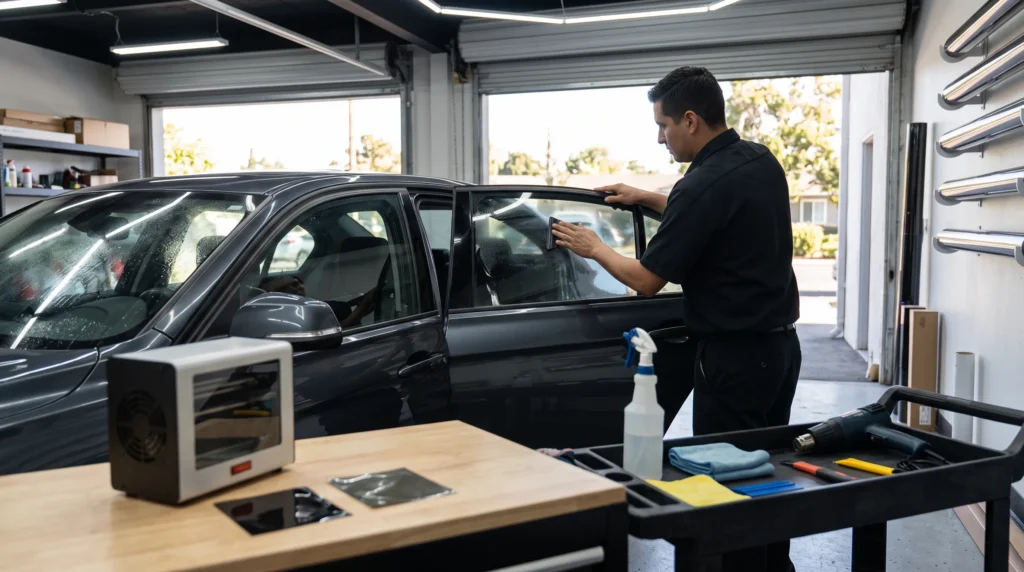
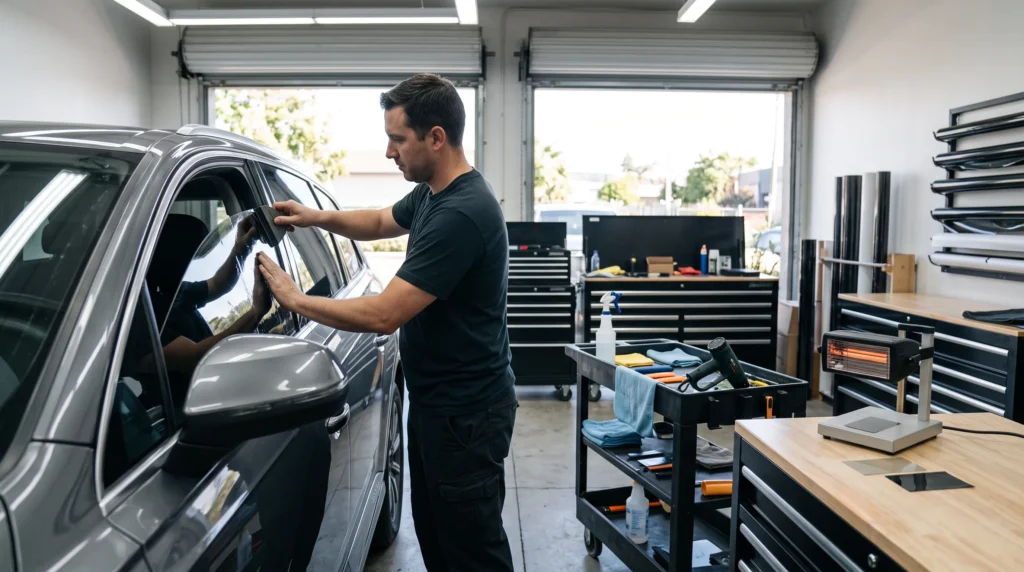
What Happens During Professional Window Tint Installation?
Professional window tint installation involves preparing the glass, fitting the film, applying it carefully, and inspecting the finished result.
The process may differ based on the glass shape and film selected.
Step 1: Review the Vehicle
The installer checks the vehicle’s window layout and existing glass condition.
This is also when you should confirm which windows will receive film and whether the proposed application meets California law.
Step 2: Clean the Glass
Dust, dirt, grease, and residue must be removed before applying film.
Small particles can become trapped beneath the material if cleaning is rushed.
Careful preparation helps produce a smoother finished appearance.
Step 3: Prepare the Film
The film is fitted to the selected glass areas.
Some curved windows require additional shaping before application.
Step 4: Apply the Tint
The installer uses an application solution to position the film.
Excess moisture is carefully removed while the film is fitted to the glass.
Step 5: Inspect the Finished Windows
The completed film is checked for alignment, visible contamination, and edge placement.
Some haze or small moisture pockets may remain while the film dries.
Step 6: Review Aftercare
Before collecting your vehicle, ask:
- How long should the windows remain closed?
- When can the tint be cleaned?
- Which cleaning products are suitable?
- What appearance changes are normal during curing?
- What should you do if an edge begins peeling?
- Which manufacturer warranty applies?
These instructions help protect the installation during the first several days.
What Affects Window Tinting in San Leandro, CA Cost?
Window Tinting in San Leandro, CA does not have one fixed cost for every vehicle.
Your quote depends on the film, vehicle, glass layout, and work required.
Film Type
Dyed, carbon, and ceramic window films use different materials.
Premium nano-ceramic products such as PRIME XR PLUS have different performance specifications from conventional films.
Number of Windows
Tinting the eligible rear windows involves different work from treating several glass areas.
The number and size of the windows affect the installation.
Vehicle Size and Shape
A compact sedan and a large SUV have different glass dimensions.
Curved rear glass, small quarter windows, frameless doors, and panoramic roofs can affect the fitting process.
Existing Window Tint
If your vehicle already has peeling, bubbled, or damaged film, removal may be needed before new tint can be installed.
The condition of the old adhesive can affect the preparation work.
Additional Glass Areas
Suitable sunroof or other glass treatments may require separate work.
Each proposed application must be compatible with the glass and comply with applicable law.
Product Selection and Warranty
Different films have different specifications and warranty terms.
Ask which XPEL product is included in your quote and what the warranty covers.
For a vehicle-specific quote, call (510) 993-9833 or use our online contact form.
How to Care for Window Tint After Installation
Your new window tint needs time to dry.
According to XPEL’s product care instructions, PRIME automotive window film may show temporary haze or moisture bubbles after installation.
These conditions can be normal while installation moisture evaporates.
Wait Before Lowering the Windows
XPEL recommends waiting approximately one to five days before lowering or cleaning newly tinted windows, depending on the climate.
Follow the specific waiting period provided by your installer.
Lowering a window too soon may disturb the film.
Allow the Film to Dry
Small moisture bubbles and haze can remain for up to ten days after installation.
Do not attempt to push, puncture, or scrape them away.
If the appearance remains unusual after the expected drying period, contact your installer.
Use Gentle Cleaning Materials
Once the film is ready to clean, use a clean microfiber towel slightly dampened with water.
XPEL also permits mild, non-ammonia glass cleaners when needed.
Avoid abrasive pads, sharp tools, and aggressive scrubbing.
Be Careful Around Tint Edges
Do not pick at the film or pull on loose edges.
If the tint begins lifting or peeling, contact the installation shop for an inspection.
Keep the Glass Clean
Regular gentle cleaning helps maintain visibility and the finished appearance.
Make sure any cleaning product you use is suitable for aftermarket window film.
Understanding the XPEL Window Tint Warranty
XCare Auto Films lists a lifetime warranty with its PRIME XR PLUS ceramic tint packages.
XPEL also advertises a limited lifetime manufacturer warranty for qualifying PRIME automotive window films.
According to XPEL’s automotive window film information, covered product issues may include:
- Bubbling
- Peeling
- Cracking
- Discoloration
Warranty coverage depends on the written terms, product eligibility, and installation requirements.
Does the Warranty Cover Every Type of Damage?
No.
A manufacturer’s film warranty should not be confused with insurance against scratches, broken glass, misuse, or other outside damage.
Ask for the written warranty information for your selected product.
Does Proper Care Matter?
Yes.
Cleaning the film according to XPEL’s instructions helps reduce the risk of avoidable damage.
Keep your installation receipt and warranty documents in case you need to request service later.
Why Choose XCare Auto Films for Window Tinting Near San Leandro, CA?
The film you choose matters, but so does the installation.
Proper glass cleaning, accurate film placement, and careful finishing affect how the windows look after the tint dries.
At XCare Auto Films, we install XPEL automotive window film at our Fremont, CA shop.
XPEL-Certified Installers
Our team is XPEL certified, and we are an XPEL vendor.
We work with genuine XPEL products backed by applicable manufacturer warranties.
PRIME XR PLUS Ceramic Window Tint
Our published ceramic tint packages feature XPEL PRIME XR PLUS.
The film is designed for strong infrared heat rejection, UV protection, and glare reduction.
We help customers compare the published film specifications and discuss appropriate window applications.
Window Tint Packages
We offer ceramic tint services for eligible glass areas, including:
- Rear side windows
- Rear quarter windows
- Rear windshields
- Suitable sunroof applications
- Other legally permitted glass treatments
Front side window and windshield installations must meet California’s specific requirements.
You can review our window tint packages before requesting a quote.
Other Vehicle Protection Services
XCare Auto Films also provides:
- Paint protection film
- Ceramic coating
- Paint correction
- Tesla window tint
- Full vehicle protection packages
Serving San Leandro and Nearby Communities
XCare Auto Films is physically located in Fremont, CA.
We welcome vehicle owners from San Leandro, CA, San Lorenzo, CA, Hayward, CA, and nearby East Bay communities.
Whether you own a Tesla, BMW, Mercedes-Benz, family SUV, pickup truck, or daily commuter, our team can help you compare suitable XPEL tint options.
Schedule Window Tinting in San Leandro, CA With XCare Auto Films
Choosing Window Tinting in San Leandro, CA starts with understanding your priorities.
If cabin heat is your main concern, compare total solar energy rejection and infrared performance.
If glare or privacy matters most, consider the film’s visible light transmission alongside California’s rules.
If you spend time on I-880 or I-580, think about how often sunlight enters through the windows during your normal commute.
XPEL PRIME XR PLUS is worth considering for owners who want premium ceramic heat rejection with suitable film choices.
At XCare Auto Films, we’ll review your vehicle’s glass layout, explain the film specifications, and discuss legally permitted applications before scheduling your appointment.
XCare Auto Films
Address: 45277 Fremont Blvd STE 7, Fremont, CA 94538
Phone: (510) 993-9833
Website: https://xcareautofilms.com
Schedule an Appointment: Contact XCare Auto Films
If you’re looking for heat-rejecting ceramic window tint near San Leandro, CA, call (510) 993-9833 or use our contact form to compare film options, request a quote, and schedule an appointment.
Frequently Asked Questions About Window Tinting in San Leandro, CA
1. What window tint rejects the most heat?
The amount of heat rejected depends on the specific product and testing method. In XPEL’s PRIME comparison, PRIME XR PLUS has the highest published infrared rejection figures among PRIME CS, PRIME XR, and PRIME XR PLUS. XPEL lists up to 96% infrared rejection, up to 70% infrared energy rejection, and up to 71% total solar energy rejection for PRIME XR PLUS, depending on the measurement and shade.
2. Is ceramic window tint worth considering for San Leandro commuters?
Yes, especially if reducing solar heat entering the cabin is your main concern. Premium ceramic films can reject more infrared energy than conventional dyed films while maintaining suitable visibility. East Bay motorists who spend time on I-880 or I-580 may appreciate the reduced heat exposure through treated glass. The vehicle will still become warm when parked in direct sunlight.
3. Does darker window tint always block more heat?
No. Darker tint reduces more visible light, but it does not automatically reject more total solar energy. A lighter ceramic film can perform better than a darker dyed film in heat-rejection testing. Compare TSER, infrared energy rejection, and VLT instead of relying only on the shade.
4. What window tint percentage is legal in California?
California has different rules for front and rear windows. Under the clear UV-protective film exception for front side windows, the material must transmit at least 88% of visible light, and the completed glass-and-film assembly must satisfy the applicable 70% minimum and other requirements. Rear side windows have different rules. Review California Vehicle Code Section 26708 before choosing a film.
5. Does XPEL PRIME XR PLUS block UV rays?
Yes. XPEL lists 99% UV rejection for PRIME XR PLUS. The film also provides infrared and total solar energy rejection, with results varying by shade and test method. UV rejection and heat rejection are different measurements, so the percentages should not be treated as equivalent.
6. How long do I need to wait before rolling down tinted windows?
XPEL recommends waiting approximately one to five days after installation before lowering or cleaning newly tinted windows, depending on the climate. Temporary moisture bubbles or haze can remain for up to ten days while the film dries. Follow the instructions given by your installer.
7. Where can I schedule ceramic window tint near San Leandro, CA?
XCare Auto Films installs XPEL automotive window tint at 45277 Fremont Blvd STE 7, Fremont, CA 94538. Our shop welcomes customers from San Leandro, CA and other East Bay communities. Call (510) 993-9833 or visit our contact page to discuss PRIME XR PLUS ceramic tint, suitable window coverage, and appointment availability.
Sources
The following manufacturer, government, and business resources support the window tint information, heat rejection specifications, legal guidance, service descriptions, and maintenance instructions in this article.
1. XCare Auto Films Window Tint Services
Title: Window Tint Services
Publisher: XCare Auto Films
Publication Date: Not listed
URL: https://xcareautofilms.com/services/window-tint/
2. XCare Auto Films Ceramic Window Tint Services
Title: Ceramic Window Tint Services
Publisher: XCare Auto Films
Publication Date: Not listed
URL: https://xcareautofilms.com/services/ceramic-window-tint/
3. XCare Auto Films Window Tint Packages
Title: Window Tint Deals and Packages
Publisher: XCare Auto Films
Publication Date: Not listed
URL: https://xcareautofilms.com/deals/window-tint-deals/
4. XPEL PRIME Window Tint Comparison
Title: XPEL PRIME Window Tint
Publisher: XPEL
Publication Date: Not listed
URL: https://lp.xpel.com/xpel-prime-window-tint
5. XPEL Automotive Window Film
Title: Automotive Window Tint
Publisher: XPEL
Publication Date: Not listed
URL: https://www.xpel.com/products/automotive-window-tint
6. XPEL Window Film Performance Specifications
Title: XPEL Product Specifications
Publisher: XPEL
Publication Date: Not listed
URL: https://www.xpel.com/product-specifications
7. XPEL Product Care Instructions
Title: XPEL Product Care Instructions
Publisher: XPEL
Publication Date: Not listed
URL: https://www.xpel.com/product-care
8. California Vehicle Code Section 26708
Title: California Vehicle Code Section 26708: Windshield and Window Restrictions
Publisher: California Legislature
Publication Date: Amended in 2025, effective January 1, 2026
URL: https://leginfo.legislature.ca.gov/faces/codes_displaySection.xhtml?sectionNum=26708.&lawCode=VEH
9. California Highway Patrol Window Tint Guidance
Title: California Highway Patrol Frequently Asked Questions
Publisher: California Highway Patrol
Publication Date: Not listed
URL: https://www.chp.ca.gov/faq/
10. City of San Leandro Transportation Information
Title: Truck Routes and Transportation Permits
Publisher: City of San Leandro
Publication Date: Not listed
URL: https://www.sanleandro.org/384/Truck-Routes-Transportation-Permits