
PPF in Newark & Union City, CA can range from protection on a few high-impact areas to film across nearly every painted exterior panel. The right amount of coverage depends on where you drive, how many freeway miles you put on the vehicle, which panels concern you most, and how long you plan to keep the car.
Newark, CA and Union City, CA drivers are surrounded by busy East Bay routes.
Newark has direct access to I-880 and SR 84, which connects drivers toward the Dumbarton Bridge and Peninsula. Union City drivers also use I-880 for travel toward Fremont, San Jose, Hayward, Oakland, and other Bay Area destinations.
That kind of driving puts the front end of a vehicle directly in the path of tire-thrown stones, grit, bugs, and other road debris.
Paint protection film, commonly called PPF, places a polyurethane film over selected surfaces so the film takes much of that contact before the factory paint does.
XCare Auto Films installs XPEL Paint Protection Film at 45277 Fremont Blvd STE 7, Fremont, CA 94538. We are XPEL certified and an XPEL vendor serving vehicle owners from Newark, CA, Union City, CA, Fremont, CA, and surrounding East Bay communities.
If you are comparing PPF in Newark & Union City, CA, here is how the most common coverage choices differ.
Table of Contents
- What Does PPF Protect Against?
- Why Newark and Union City Drivers Consider PPF
- Option 1: Front Bumper PPF
- Option 2: Partial Front PPF
- Option 3: Full Front PPF
- Option 4: Full Front Plus Rocker Panels
- Option 5: High-Contact PPF Areas
- Option 6: Full-Body PPF
- PPF Coverage Options Compared
- Which Panels Get Hit Most on I-880?
- Why SR 84 and Dumbarton Bridge Driving Matters
- Should You Protect Rocker Panels?
- PPF for Teslas and EVs
- XPEL ULTIMATE PLUS for East Bay Driving
- What About XPEL ULTIMATE FUSION?
- XPEL STEALTH and COLOR PPF
- Does PPF Stop Every Rock Chip?
- PPF vs Ceramic Coating
- Does Paint Correction Come Before PPF?
- How to Choose Your PPF Coverage
- Schedule PPF Near Newark and Union City, CA
- Frequently Asked Questions
What Does PPF Protect Against?
PPF in Newark & Union City, CA is aimed at physical paint protection.
XPEL describes its ULTIMATE PLUS Paint Protection Film as an 8 mil film designed to guard against:
- Rock chips
- Scratches
- Road debris
- Environmental contaminants
- Light surface marks
The film sits on top of the vehicle surface.
When a small stone reaches a protected bumper or hood, it meets polyurethane film before reaching the factory clear coat and paint underneath.
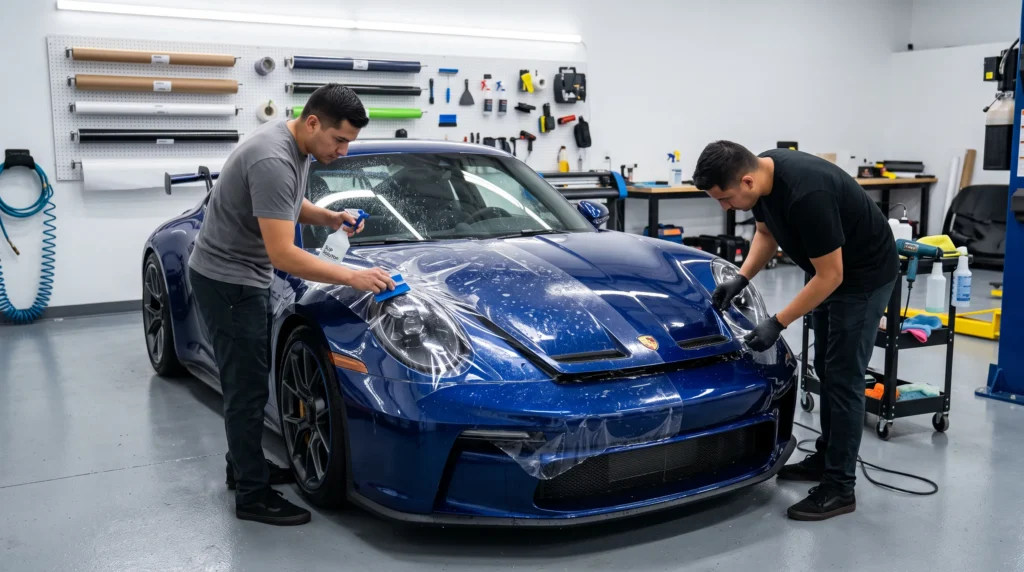
That physical barrier is what separates PPF from products such as wax or ceramic coating.
Where you install the film determines which panels receive that barrier.
Why Newark and Union City Drivers Consider PPF
Newark, CA sits between Fremont and Union City and has easy access to I-880 and SR 84.
SR 84 also gives Newark drivers direct access toward the Dumbarton Bridge and Peninsula.
Union City, CA sits along the same I-880 corridor.
That means drivers from both cities may spend a large share of their weekly mileage on roads where vehicles travel at freeway speeds.
Normal commuting can expose a vehicle to:
- Loose stones
- Tire-thrown grit
- Bug impact
- Road film
- Construction debris
- Dust
- Tire spray
- Small scratches
The question is not whether every vehicle needs full-body PPF.
The real question is which areas you want covered.
Option 1: Front Bumper PPF
The smallest focused coverage option may start with the front bumper.
The bumper sits at the leading edge of the vehicle and often receives direct contact from road debris.
Modern front bumpers can also contain:
- Parking sensors
- Cameras
- Grilles
- Air openings
- Splitters
- Vents
- Sharp body lines
- Tight corners
PPF installed over the bumper creates a sacrificial surface for those daily impacts.
Who Might Choose Bumper-Only Coverage?
This can make sense for someone whose biggest concern is the painted front bumper but who is not ready for broader coverage.
The tradeoff is simple.
The hood, fenders, mirrors, and other exposed panels remain uncovered.
If freeway rock chips are your main concern, you may decide that wider front-end coverage gives you a better match for your driving.
Option 2: Partial Front PPF
Partial Front PPF goes farther.
Coverage varies by installer and vehicle, but a partial-front setup may include areas such as:
- Front bumper
- Part of the hood
- Part of the front fenders
- Side mirrors
This approach puts film on several high-impact areas while using less material than Full Front coverage.
There is one visual difference worth understanding.
When only part of the hood is covered, the PPF must end somewhere across the panel.
That creates a film edge.
The same thing can happen on partially covered fenders.
Some owners do not mind seeing that line.
Others prefer full-panel coverage.
Ask the installer where each piece of film will stop before choosing the package.
Option 3: Full Front PPF
Full Front is one of the most practical choices for drivers researching PPF in Newark & Union City, CA because it focuses film on the surfaces facing traffic and road debris.
A Full Front setup commonly includes:
- Full front bumper
- Full hood
- Full front fenders
- Side mirrors
- Headlights where suitable
This provides broader front-end protection than partial coverage.
It also removes the film line across the middle of a partially covered hood or fender because the entire painted panel receives film.
Why Full Front Works Well for Commuters
Think about what your vehicle faces during a normal trip on I-880.
The front bumper meets debris first.
Small stones can travel upward toward the hood.
Front fenders face the road while sitting close to the tires.
Mirrors extend outside the main body where bugs and small debris can strike them.
For drivers whose main concern is freeway wear, Full Front PPF puts coverage where much of that exposure occurs.
Option 4: Full Front Plus Rocker Panels
The front end is not the only part of a vehicle that encounters debris.
Your own tires can throw grit toward the lower body.
This can make rocker panels worth adding to Full Front coverage.
Rocker-panel PPF may make sense for:
- Sports cars
- Teslas
- EVs
- Vehicles with wide tires
- Low vehicles
- Cars with flared bodywork
- High-mileage commuters
If the lower sides of your vehicle become covered with grime after freeway driving, look closely at where that residue lands.
Those same areas may also receive small stones and road grit.
Adding PPF there can extend protection beyond the direct front-impact zone.
Option 5: High-Contact PPF Areas
Not every PPF area is selected because of freeway rock chips.
Some small sections are covered because they face repeated human contact or loading.
High-contact PPF can include:
Door Cups
The painted area behind a door handle can collect fingernail marks.
Small pieces of clear film can help protect that surface.
Door Edges
Door edges can pick up scuffs when entering or exiting tight parking spaces.
Rear Bumper Loading Area
Loading luggage, sports equipment, strollers, tools, or other items can leave scratches across the top of a rear bumper.
Rear Wheel Impact Areas
Some vehicle designs place painted panels directly in the path of debris coming from the rear tires.
Rocker Panels
Shoes, road grit, and tire spray can all reach these low sections.
These areas can be added to a front-end package when they match your concerns.
Option 6: Full-Body PPF
Full-body PPF extends film across nearly all painted exterior surfaces.
Coverage may include:
- Hood
- Front bumper
- Front fenders
- Doors
- Rocker panels
- Rear quarter panels
- Rear bumper
- Trunk or hatch
- Roof where appropriate
- Mirrors
- Other painted exterior areas
This uses far more film and installation work than a Full Front package.
It also gives the owner much broader paint coverage.
Who May Consider Full-Body PPF?
Full-body film may appeal to:
- Exotic-car owners
- Luxury-vehicle owners
- Collectors
- Performance-car owners
- Owners of specialty factory paint
- Long-term vehicle owners
- Drivers who want fewer exposed painted panels
A daily commuter does not automatically need this amount of coverage.
The decision comes down to how much factory paint you want covered.
PPF Coverage Options Compared
Here is a simple comparison.
| Coverage | Areas Commonly Covered | Good Fit For |
|---|---|---|
| Front Bumper | Front bumper | Focused bumper protection |
| Partial Front | Bumper, part of hood, part of fenders, mirrors | Smaller front-end coverage |
| Full Front | Bumper, full hood, full fenders, mirrors, headlights where suitable | Freeway commuters |
| Full Front + Rockers | Full Front plus lower rocker areas | Wide-tire and high-mileage vehicles |
| High-Contact Areas | Door cups, edges, loading zones, impact areas | Daily-use wear |
| Full Body | Most painted exterior surfaces | Broad paint protection |
The exact coverage can change based on vehicle design.
Ask XCare Auto Films to identify the panels included for your vehicle before scheduling.
Which Panels Get Hit Most on I-880?
I-880 runs through the East Bay and serves both Newark, CA and Union City, CA.
Union City planning documents describe it as the freeway connecting the San Jose area to Oakland and the Bay Bridge.
That makes it a regular route for many local commuters.
A vehicle traveling I-880 may face debris on several surfaces.
Front Bumper
Direct forward exposure makes this a common chip area.
Hood
Stones thrown by traffic ahead can reach the leading edge and farther back across the panel.
Front Fenders
Fenders sit close to both road and tire activity.
Mirrors
Side mirrors can collect bugs and small debris.
Rocker Panels
Tires can send grit toward lower bodywork.
If you drive I-880 several days each week, those areas deserve a close look when deciding how much PPF to install.
Why SR 84 and Dumbarton Bridge Driving Matters
Newark, CA also has direct access to SR 84.
The City of Newark identifies SR 84 and the Dumbarton Bridge as a connection from Newark toward the Peninsula.
That can mean more freeway miles for drivers commuting toward Menlo Park, Palo Alto, Redwood City, or surrounding areas.
More freeway mileage means more opportunities for road debris to reach the vehicle.
That does not mean every Dumbarton commuter needs full-body film.
A Full Front package may cover the areas that concern many freeway drivers most.
If rocker panels or lower doors also show wear, those sections can be discussed separately.
Should You Protect Rocker Panels?
Look at your own car after a week of driving.
If the rocker panels are covered in road film and tire spray, that tells you something about their exposure.
This can be more noticeable on vehicles with:
- Wide tires
- Low ride height
- Aggressive wheel fitment
- Flared body panels
Rocker-panel PPF places film on a surface that might otherwise collect grit directly against the paint.
It can be paired with Full Front PPF without moving all the way to full-body film.
For many commuters, choosing targeted areas this way creates a sensible middle ground.
PPF for Teslas and EVs
Newark, CA and Union City, CA have plenty of Tesla and EV drivers traveling between the East Bay and Silicon Valley.
Electric vehicles often have smooth front-end shapes and large painted bumpers.
A Tesla Model 3 or Model Y commuter may consider PPF on:
- Front bumper
- Hood
- Front fenders
- Mirrors
- Rocker panels
- Rear wheel impact areas
XCare Auto Films offers Tesla Paint Protection Film and can discuss coverage based on the Tesla model and how it is driven.
The same principle applies to other EVs.
Choose the panels receiving the exposure you want to reduce.
XPEL ULTIMATE PLUS for East Bay Driving
XCare Auto Films installs XPEL Paint Protection Film products.
XPEL currently describes ULTIMATE PLUS as 8 mil thick.
The film is designed to protect against scratches, chips, and environmental contaminants while keeping a nearly invisible clear appearance.
XPEL also uses self-healing surface technology for minor scratches and swirl marks in the film.
That makes ULTIMATE PLUS a strong option for owners who want to preserve the factory paint color.
Learn more about our Paint Protection Film service.
What About XPEL ULTIMATE FUSION?
XPEL ULTIMATE FUSION combines PPF with a hydrophobic topcoat.
It provides the physical film barrier associated with PPF while adding water-repelling surface behavior.
For an East Bay commuter, that may appeal when both road impact and easier cleaning matter.
ULTIMATE PLUS and ULTIMATE FUSION should not be chosen only by product name.
Ask what you want from the film.
If water behavior carries weight in your decision, ask XCare Auto Films how ULTIMATE FUSION compares with other XPEL PPF choices.
XPEL STEALTH and COLOR PPF
PPF can also change how a vehicle looks.
XPEL STEALTH
XPEL STEALTH is used for satin-style protection and can work with compatible matte finishes or create a satin appearance across covered surfaces.
XPEL COLOR
XPEL COLOR PPF changes the visible vehicle color while providing paint protection film coverage.
Drivers considering a full exterior change can ask whether XPEL COLOR PPF fits their goals.
These products solve a different appearance need from clear ULTIMATE film.
Does PPF Stop Every Rock Chip?
No.
XPEL designs PPF to protect against chips and scratches, but no film makes a vehicle impossible to damage.
A hard enough strike may:
- Cut the film
- Tear the film
- Dent a body panel
- Damage paint underneath
- Damage an uncovered section
This distinction also appears in warranty language.
XPEL’s 10-year ULTIMATE PLUS limited warranty covers listed manufacturing defects such as yellowing, cracking, blistering, and delaminating when warranty conditions are met.
That warranty is not a promise that every external impact will leave the film untouched.
PPF is a sacrificial barrier.
Its job is to take exposure before the paint underneath.
PPF vs Ceramic Coating
PPF and ceramic coating are not interchangeable.
PPF Helps With
- Rock chips
- Road debris
- Scratches
- Scuffs
- Physical contact
Ceramic Coating Helps With
- Water behavior
- Easier cleaning
- Gloss
- Surface grime
- Contamination resistance
If your main concern is I-880 rock chips, PPF is the service to discuss first.
If your concern is making the vehicle easier to wash, ceramic coating may fit.
Many owners use both.
PPF can protect high-impact sections while compatible surfaces receive ceramic coating for easier exterior care.
Does Paint Correction Come Before PPF?
Sometimes.
PPF is transparent, so the condition underneath still affects the finished appearance.
A vehicle may have:
- Swirl marks
- Fine scratches
- Water spots
- Haze
- Previous polishing marks
- Bonded contamination
Not every vehicle needs paint correction before PPF.
The paint should be inspected first.
A newer vehicle with clean paint may need little correction.
A used vehicle covered in wash marks may benefit from polishing before film is installed.
XCare Auto Films can inspect the paint and discuss whether correction belongs in the project.
How to Choose Your PPF Coverage
Start with your driving.
Ask yourself:
- How many miles do I drive on I-880 each week?
- Do I regularly use SR 84 or the Dumbarton Bridge?
- Is my front bumper already chipped?
- Do I want the whole hood covered?
- Do I mind a visible partial-film edge?
- Do my rocker panels collect heavy road grime?
- Does my vehicle have wide tires?
- Do I want door cups or door edges covered?
- How long do I plan to keep the vehicle?
- Do I want clear film or an appearance change?
Then compare the coverage.
A bumper-only installation covers one high-impact area.
Partial Front adds more protection.
Full Front puts film across the major forward-facing panels.
Adding rocker panels helps protect lower side areas.
Full-body PPF covers far more of the vehicle.
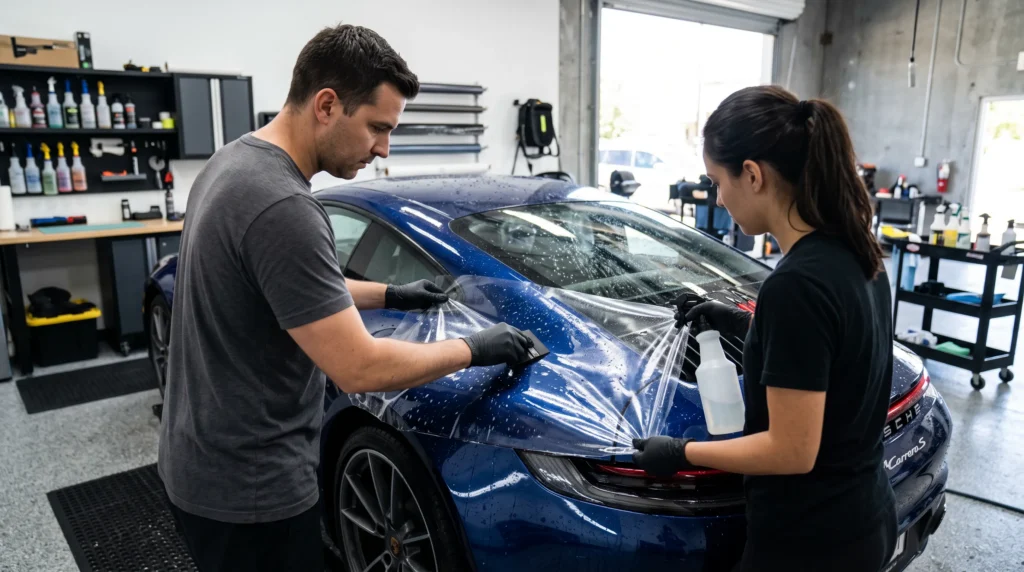
The right PPF in Newark & Union City, CA plan is the one that puts film where your vehicle actually needs it.
Schedule PPF Near Newark and Union City, CA
XCare Auto Films installs XPEL Paint Protection Film from our Fremont, CA shop.
Our location is:
XCare Auto Films
45277 Fremont Blvd STE 7
Fremont, CA 94538
Phone: (510) 993-9833
Hours: Monday through Friday, 11 AM to 7 PM
We work with drivers from Newark, CA, Union City, CA, Fremont, CA, and surrounding East Bay communities.
We install:
- XPEL ULTIMATE
- XPEL ULTIMATE FUSION
- XPEL STEALTH
- XPEL COLOR
- Ceramic Coating
- Paint Correction
- Window Tint
Call (510) 993-9833 or use our contact page to discuss your vehicle and the areas you want covered.
You can also review:
- Paint Protection Film
- PPF Deals
- Tesla Paint Protection Film
- Paint Correction
- Ceramic Coating
- Full Protection Packages
- Our Services
- Contact XCare Auto Films
Bottom line, PPF in Newark & Union City, CA does not have to mean covering the entire vehicle.
You can focus on the bumper.
You can cover part of the front.
You can choose Full Front protection.
You can add rocker panels and smaller high-contact areas.
Or you can cover nearly every painted exterior panel.
For regular I-880 and SR 84 drivers, the front bumper, hood, fenders, mirrors, and lower side areas are good places to inspect first.
Choose coverage based on your commute, your vehicle, and the paint you want protected.
Frequently Asked Questions
1. What PPF coverage is good for an I-880 commuter?
Many freeway drivers start by comparing Partial Front and Full Front PPF. Full Front commonly covers the bumper, full hood, full front fenders, mirrors, and headlights where suitable. Drivers with exposed lower panels may also add rocker-panel coverage.
2. What is the difference between Partial Front and Full Front PPF?
Partial Front covers only part of certain panels, such as the hood and fenders. Full Front covers the full hood and full front fenders along with the bumper and other front-impact areas. Full-panel coverage avoids a film edge across the middle of the hood.
3. Should Newark, CA drivers get rocker-panel PPF?
It depends on the vehicle. Rocker panels can receive grit and tire spray, especially on low vehicles, performance cars, Teslas, and vehicles with wide tires. Inspect how dirty the lower panels become after regular driving.
4. Does PPF protect against every rock chip?
No. XPEL PPF is designed to guard against rock chips, scratches, and road hazards, but a severe impact can still damage the film or vehicle underneath. PPF reduces direct exposure rather than making paint impossible to damage.
5. Is ceramic coating the same as PPF?
No. PPF is a physical film used for impact and scratch protection. Ceramic coating is a much thinner surface treatment associated with water beading, gloss, and easier cleaning. The two can be used together.
6. Does XCare Auto Films install Tesla PPF for Newark and Union City drivers?
Yes. XCare Auto Films offers Tesla Paint Protection Film from our Fremont, CA shop. Call (510) 993-9833 to discuss coverage for your Tesla.
7. Where can I schedule PPF near Newark, CA and Union City, CA?
XCare Auto Films installs XPEL Paint Protection Film at 45277 Fremont Blvd STE 7, Fremont, CA 94538. Call (510) 993-9833 or visit our contact page to schedule an appointment.
Sources
- XPEL ULTIMATE PLUS Paint Protection Film
Publisher: XPEL
Publication Date: Not stated
URL: https://www.xpel.com/products/ultimate-plus - XPEL Warranty Information
Publisher: XPEL
Publication Date: Not stated
URL: https://www.xpel.com/warranty-information - Public Transportation
Publisher: City of Newark
Publication Date: Not stated
URL: https://www.newarkca.gov/visitors/public-transportation/ - Union City Transportation
Publisher: City of Union City
Publication Date: 2025 document version available online
URL: https://www.unioncity.org/DocumentCenter/View/8018/312-Transportation - Paint Protection Union City, CA
Publisher: XCare Auto Films
Publication Date: Not stated
URL: https://xcareautofilms.com/service/paint-protection-in-union-city-ca/ - Tesla PPF Union City, CA
Publisher: XCare Auto Films
Publication Date: Not stated
URL: https://xcareautofilms.com/service/tesla-ppf-in-union-city-ca/